

Mandatory time tracking in Spain: everything you need to know in 2026
Royal Decree-Law 8/2019 requires all companies to record their employees' working hours. Here's what you need, what fines you risk, and how to comply without complications.
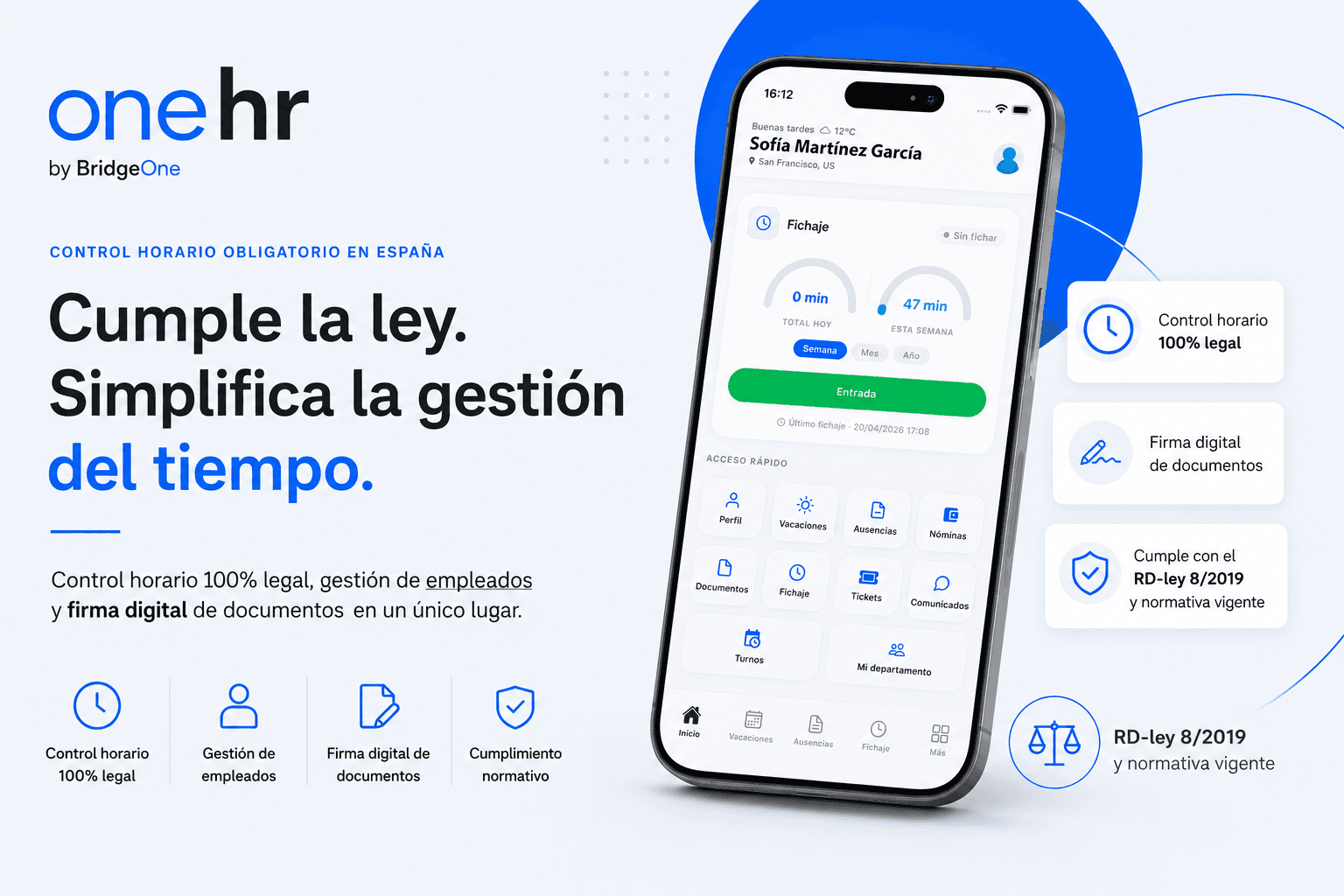
Since Royal Decree-Law 8/2019 came into force, every company in Spain, regardless of size or sector, is required to record the daily working hours of each employee. This is not a recommendation or a best practice: it is a legal obligation, and the Spanish Labour Inspectorate actively enforces and sanctions it.
What exactly does the law require?
The record must reflect, at minimum, the start time and end time of each employee's working day, every day. Recording just the total hours worked per month, or an estimated count, is not enough: the law requires a daily, objective and reliable time record.
- It applies to full-time and part-time employees, permanent and temporary, on-site and remote.
- Records must be kept for at least 4 years and be available to the employee, their legal representatives, and the Labour Inspectorate.
- There's no single official template, but the system must be objective and reliable, not based on the employee's or employer's word alone.
What happens if you fail to comply?
Failure to keep a time record is classified as a serious infringement under Spain's Law on Infringements and Sanctions in the Social Order (LISOS, the statute setting labor-law penalties). Penalty amounts are periodically updated, so it's worth always checking the current figures, but as a general guide, serious infringements in this area range from several hundred to several thousand euros per infringement, and can multiply if it affects several employees or there's repeat non-compliance.
Beyond the financial penalty, a poor time-tracking record puts a company at a clear disadvantage in the event of an overtime claim: without a reliable record, the burden of proof tends to favor the employee.
Spreadsheets, physical clock-in, or software: which option actually works?
Many companies still try to comply using a shared spreadsheet. It works while the team is small, but becomes unworkable as it grows: nobody reviews issues in real time, it's easy to alter after the fact, and it provides no useful aggregated data for HR.
- Shared spreadsheet: zero upfront cost, but no real objectivity — anyone can edit a cell after the fact, with no record of who did it or when.
- Physical clock-in (card or fingerprint): objective and reliable, but doesn't cover remote workers or those working across several sites, and requires manually transferring data to produce any report.
- Digital time-tracking software: covers on-site, remote and multi-site work at once, with records and reports generated automatically, with no added manual work.
A digital time-tracking system solves all three problems at once: it records the actual clock-in and clock-out time (from the web, a mobile app with geolocation, or a physical device), keeps an unalterable history, and automatically generates the reports a labour inspector would request, with nobody having to chase anyone with a spreadsheet.
How One HR solves this
In One HR, time tracking is built in by default, not a separate paid module: each employee clocks in from the web, the mobile app (with optional GPS for mobile teams), or a physical device at the workplace, and HR has a live dashboard showing who is working, on a break, or absent at any given moment. Records are stored and exportable as PDF or Excel, ready for a labour inspection, with no preparation needed.
Frequently asked questions
Is time tracking mandatory for every company?
Yes, Royal Decree-Law 8/2019 requires every company, regardless of size or sector, to record the daily working hours of each employee.
What must the time record show at minimum?
Each employee's start and end time every day; an estimated monthly total is not enough.
How long do records need to be kept?
At least 4 years, and they must be available to the employee, their representatives and the Labour Inspectorate.
What penalties does a company without time tracking risk?
It's classified as a serious infringement under LISOS, with penalties ranging from several hundred to several thousand euros per infringement.